
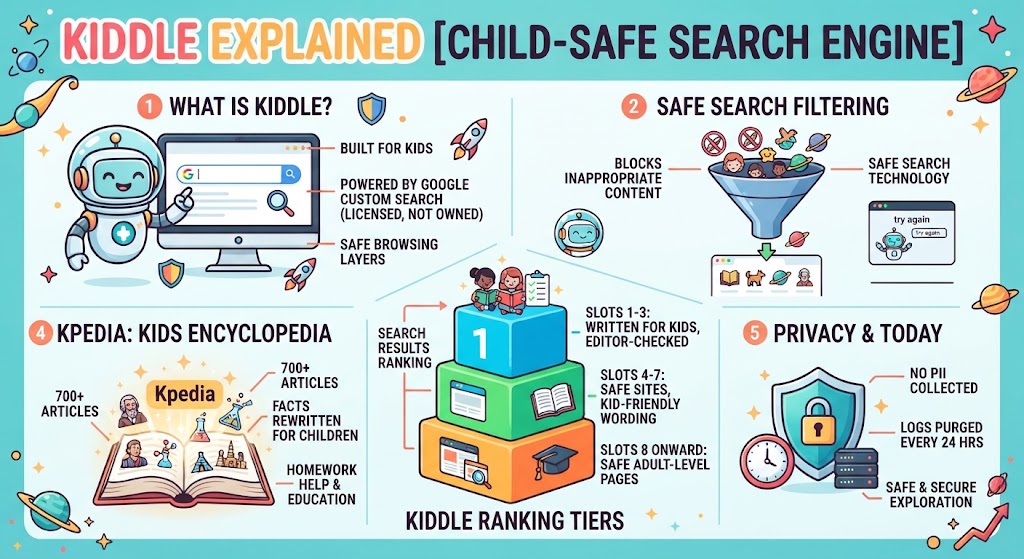
Kiddle, usually written as Kiddle.co after its address, is a search engine and encyclopedia built for children. Searches run on Google Programmable Search Engine with SafeSearch and extra filters layered on top. Google licenses that technology but does not own the site. This guide covers ranking rules, what Kpedia holds, and the keyword row that still shapes the site’s reputation.
What Is Kiddle and Who Runs It
The Kiddle domain was registered in 2014. Its designers picked a .co ending to signal a children-only audience, which is also why kiddle.com goes somewhere else entirely.
Kiddle is not a Google product. It uses Google Custom Search under licence, and BBC News and CBC News have both reported no corporate link. Several blogs got this wrong anyway, and the mix-up has stuck. Readers who enjoy tracing how small sites operate may want this breakdown of icostamp.com as a comparison.
The homepage carries an outer-space theme with a robot mascot. Four dates mark the site’s history:
- 2014 — domain registered, .co chosen for “children only”
- 2016 — heavy social media attention, plus a short keyword-blocking spell that turned into a meme
- July 2023 — Spanish edition launched at es.kiddle.co
- September 2025 — redrawn logo, brighter homepage
How Kiddle Ranks Search Results
Type a topic into the box and Kiddle sorts what comes back by how suitable it is for young readers. Everything shown has already passed through SafeSearch.
Slots one to three hold pages written for kids and checked by Kiddle editors. Slots four to seven hold safe sites not written for children but worded simply enough. From slot eight onward, results are safe adult-level pages that a child will find harder to read.
The split above shows how the first ten result slots on a Kiddle page divide across those three tiers.
Enter a term the filter dislikes and no list loads at all. A cartoon robot appears instead and asks the visitor to try again. That screen fires before any page is fetched, which is a stricter approach than the utility pages at g15tools.com or the open browser hubs students reach on locked school networks take.
Kpedia: The Kiddle Encyclopedia for Kids
Kpedia is the reference library reachable straight from the search box. It lists more than 700,000 articles, all based on selected content and facts from Wikipedia and rewritten for children.
Kiddle presents Kpedia as a tool for school homework help and general education, and its entries show up inside ordinary search listings. The software behind it is MediaWiki, the same engine Wikipedia runs on. Kpedia content carries an Attribution-ShareAlike licence for personal and educational use.
For kids who finish a research task early, teachers often keep something light on hand, whether that is a round of the Google memory game or a hosted Gimkit session.
The 2016 Kiddle Keyword Blocking Controversy
Not every decision here landed well. In 2016 Kiddle drew criticism for blocking a range of LGBT-related search terms. Its stated reason was that those keywords were not suitable for small children.
Public pressure followed, and Kiddle announced it would unblock them. Common Sense Media noted at the time that terms including “gay” and “transgender” had returned. Ten years on, that episode is still the objection people raise first.
Screening also catches words that carry adult meanings elsewhere. Health and biology queries have been walled off as a result, which frustrates older children doing legitimate research.
Is Kiddle Safe for Kids?
Mostly, with gaps. Sophos found that a search for the number 14 returned age-appropriate results on Kiddle, while the same query on Google SafeSearch surfaced hate-group context a young child does not need.
The filters can be worked around. Bark reported that a blocked term returned nothing, but an alternate spelling using a digit did return results. Common Sense Media found harsh images such as true-crime stills slipping through occasionally.
On privacy, Kiddle requires no registration, states that it collects no personally identifiable information, and purges server logs every 24 hours. Supervision still matters, the same way it does with archive sites that security scanners flag.
What Kiddle Offers Today
Two things sit under one roof: a filtered route into the open web, and a rewritten encyclopedia for school-age readers. Ranking pushes checked, simpler pages to the top, then steps toward adult writing further down.
The robot screen stops unsuitable queries before results load. Google’s search technology powers all of it under licence rather than ownership, which explains the recurring confusion over who runs the site. For more explainers in the same format, there is this rundown of izonemedia360.com.
FAQs
Is Kiddle owned by Google?
No. Kiddle runs on Google Programmable Search Engine under licence, but Google LLC has no ownership stake. Matching colours and prominent SafeSearch branding cause the confusion, and several news outlets have repeated the error.
Is Kiddle safe for kids to use?
Largely yes. SafeSearch, editor review and keyword screening block most explicit material. Common Sense Media found harsh images can still appear, and alternate spellings bypass some blocks, so adult supervision remains useful.
What do parents on Reddit say about Kiddle?
Reddit parenting and teaching threads tend to treat Kiddle as a starting filter rather than a complete answer. Recurring complaints cover over-blocking of health terms and results that feel thin for older children.
Is Kiddle a reliable source for homework?
Kpedia rewrites Wikipedia material for young readers, so accuracy tracks the original entry. Most teachers accept it for background reading and ask for primary sources when work is graded.
What are the main Kiddle alternatives?
KidRex and KidzSearch come up most often, and Reddit users also point to Common Sense Media reviews before picking one. Each runs a similar filtered layer over a mainstream search index.
