
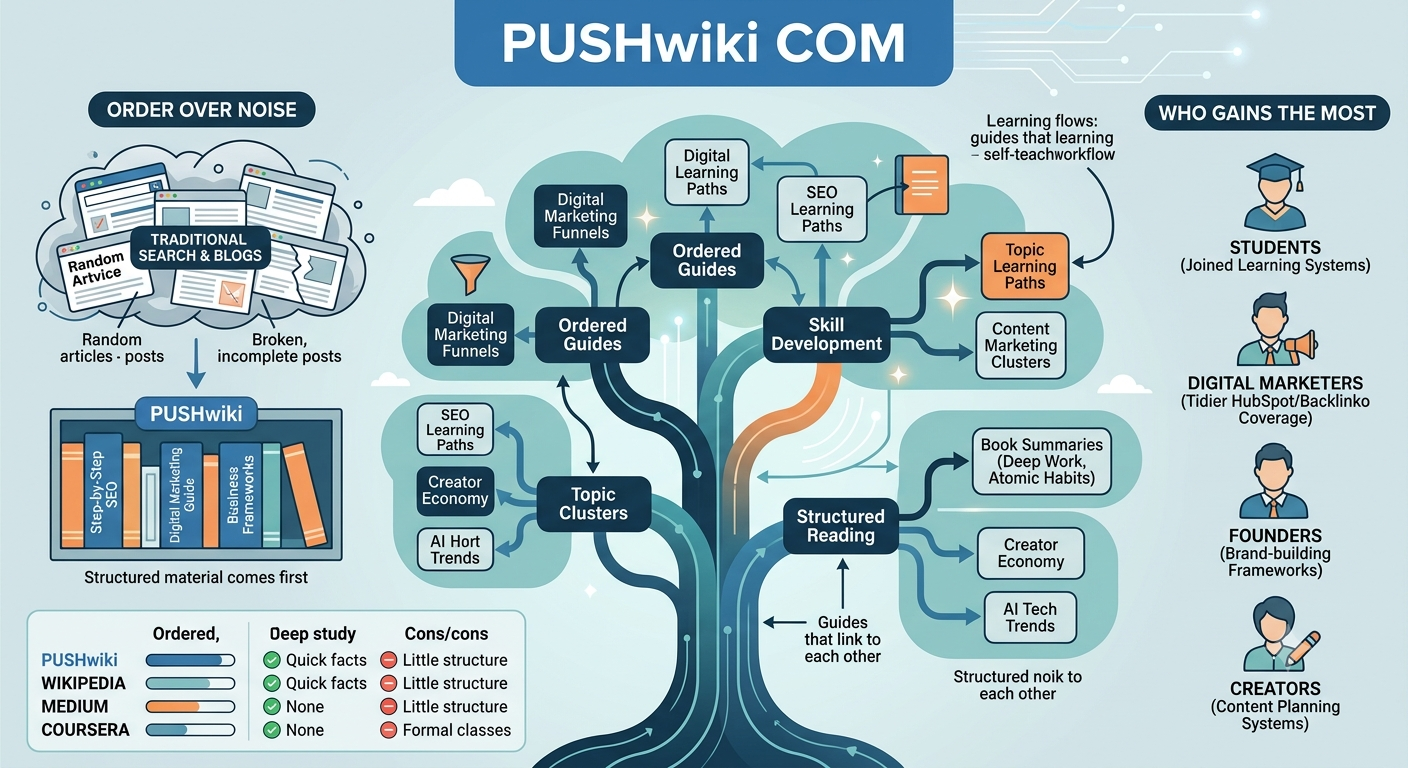
Look up one small thing online and you end up with ten tabs, stale advice, and posts that stop halfway. Pushwiki com sets out to close that gap.
It sorts information into a shape you can use. Instead of loose articles, you get guides that link to each other and study time that feels planned.
What Is Pushwiki Com and Why It Matters Now
PushWiki.com works as a shared knowledge base that turns heavy subjects into tidy study systems. Picture Wikipedia, Coursera, and long-form blogging mixed together, with tighter shape and a firmer aim.
The problem it answers is volume. Medium and small niche sites publish without pause, yet rarely tie ideas together. PushWiki reverses that order.
Structured material comes first, then grows outward through topic clusters. Self-teachers get a workflow that helps facts stick and cuts wasted hours.
Order Over Noise
Most sites chase visits. PushWiki chases plain sense.
Try picking up SEO from scattered blogs. One covers keywords. Another leaps to backlinks. A third names Ahrefs or SEMrush with no setup. PushWiki lays the same subject out as a guided route, closer to a book than a feed.
Inside Pushwiki Com: How the Build Works
| Layer | What it handles |
|---|---|
| Content | Long guides with staged steps and real cases. Digital marketing splits into content marketing, email funnels, and conversion rate optimisation. |
| Organisation | Clusters and firm information architecture join every piece, which builds topical authority. Machines read it better, and so do you. |
| Reading | Tidy pages, no clutter, no pushy ads. Readability climbs, so you finish what you open. |
| Updating | Pages shift as trends move, covering technology trends and influencer marketing. Slower than news sites, deeper in return. |
What You Find on Pushwiki Com
Guides and Learning Paths
Practical guides carry the weight. A blogging guide moves through niche picking, keyword research, and earning money.
Marketing and SEO get deep treatment, including tools such as Google Analytics. Related material links inward, so a content marketing guide points to copywriting, audience building, and funnels. Dead ends disappear.
Book Breakdowns and Trend Coverage
Book summaries pull from Thinking, Fast and Slow by Daniel Kahneman, Atomic Habits by James Clear, Deep Work by Cal Newport, and Hooked by Nir Eyal. They aim at use, not theory.
Trend pieces cover the creator economy, TikTok Shop, and AI inside knowledge sites. Semantic SEO and planning frameworks join subjects without forcing them.
Who Gets the Most From Pushwiki Com
| Reader | Gain |
|---|---|
| Students | One joined system instead of hopping between Khan Academy and stray blogs |
| Digital marketers | Clear coverage of paid advertising and CRO, like a tidier HubSpot Blog or Backlinko |
| Founders | Brand-building and audience growth frameworks that skip painful trial and error |
| Creators | Systems for YouTube growth, Substack, and content planning |
Students gain most on the reading side and least on the practice side. PushWiki explains a subject but never tests you, so classrooms still lean on game-based recall, and the split between Blooket and Kahoot shows why format matters as much as content.
Pushwiki Com Compared With Wikipedia, Medium, and Coursera
| Site | Strong side | Weak side |
|---|---|---|
| PushWiki | Ordered, deep study | Still expanding |
| Wikipedia | Quick facts | Shallow coverage |
| Medium | Simple publishing | Little structure |
| Coursera | Formal classes | Heavy time cost |
Where Pushwiki Com Falls Short
Some niches stay thin. There are no quizzes, no scoring, and no certificates. Setups built around play cover that side better, whether that means creating a Gimkit teacher account or dropping into a live Kahoot round with a class.
How to Use Pushwiki Com Properly
Pick one subject and stay there. Follow the internal links as designed, then branch into connected guides.
Write notes and act on them. Rereading feels productive and rarely is, which is why goal-based practice assignments or a short drill through a Quizizz account pins facts down faster than a second pass.
Learning SEO shows the pattern. Basics, then keyword research, then tools, then technical work. Each stage rests on the last.
What Comes Next for Pushwiki Com
Expect AI personalisation, automation, and sharper study routes. Creator-led publishing and no-code tools already push that way.
Most pages appear open, though paid tiers could arrive. Beginners cope fine. For quick answers, blogs still serve. For real study in 2026, pushwiki com earns the time.
FAQs
What is pushwiki com?
Pushwiki com is a knowledge platform publishing structured guides on SEO, blogging, digital marketing, and self-learning. Articles connect through topic clusters instead of standing alone as separate posts.
Is pushwiki com free to use?
Most pages are open with no paywall or sign-up. Paid tiers could arrive later, though nothing currently blocks access to the guides.
Is pushwiki com better than Wikipedia for learning?
For quick facts, Wikipedia wins. For working through a subject in order, pushwiki com goes deeper because its guides are staged rather than encyclopaedic.
Who should use pushwiki com?
Students, digital marketers, founders, and creators. Anyone teaching themselves without a course gains most, since the internal links act as a reading order.
Does pushwiki com offer quizzes or certificates?
No. There is no testing layer, scoring, or certification. Readers who want practice pair the guides with classroom quiz tools that use shared join codes.
