
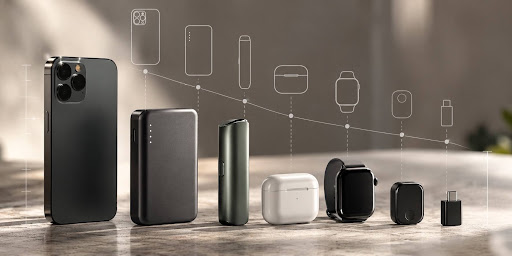
In 1983, making a call on the move meant lifting something about the size of a house brick. Today, a phone thinner than a pencil does a million more things and weighs a fraction as much.
Miniaturization is one of the biggest stories in consumer tech, and the numbers behind it are pretty wild. Here’s how much our gadgets have shrunk, and where the shrinking seems to stop.
Key statistics at a glance
- The first commercial mobile phone weighed 785 g (28 oz); a 2025 iPhone Air weighs 165 g (5.8 oz).
- The first commercially successful portable computer weighed 11.1 kg (24.5 lb); a 13-inch MacBook Air weighs about 1.24 kg (2.7 lb).
- Lithium-ion batteries now store over 700 watt-hours per liter, up from about 200 in 1991.
- Smartphones got lighter until the early 2010s, then grew heavier again as screens and batteries got bigger.
How much did the first mobile phone weigh?
The Motorola DynaTAC 8000X, the first commercially available mobile phone, went on sale in 1983. According to Guinness World Records, it weighed 785 g (28 oz) and measured 300 x 44 x 89 mm, which is why its own creators nicknamed it “The Brick”.
It wasn’t just heavy. Ericsson’s history archive notes that its battery gave 30 minutes of talk time and took 10 hours to recharge. It cost $3,995.
Compare that with the iPhone Air, released in September 2025. It weighs 165 g (5.8 oz) and is just 5.6 mm (0.22 in) thick. That’s nearly five times lighter than the DynaTAC, with a battery that lasts all day.
How much lighter have portable computers become?
The Osborne 1, launched in 1981, is often called the first commercially successful portable computer. It weighed 24.5 lb (11.1 kg), had a 5-inch screen and cost $1,795. It was roughly the size of a sewing machine and was advertised as fitting under an airline seat.
A 13-inch MacBook Air today weighs about 1.24 kg (2.7 lb). That’s around nine times lighter, with a screen more than twice as big and computing power the Osborne’s designers couldn’t have imagined.
How do device weights compare, then and now?
Here’s a side-by-side look at some milestone devices and what they weigh:
| Device | Year | Weight | What it shows |
|---|---|---|---|
| Osborne 1 portable computer | 1981 | 11.1 kg (24.5 lb) | Where “portable” computing started |
| Motorola DynaTAC 8000X | 1983 | 785 g (28 oz) | The first commercial mobile phone |
| Original iPod | 2001 | 184 g (6.5 oz) | A music library in your pocket |
| Original iPhone | 2007 | 135 g (4.8 oz) | The smartphone era begins |
| iPhone 5 | 2012 | 112 g (3.95 oz) | Around the low point for phone weight |
| iPhone 14 Pro Max | 2022 | 240 g (8.5 oz) | Bigger screens and batteries add weight |
| AirPods Pro 2 (one earbud) | 2022 | 5.3 g (0.19 oz) | Electronics small enough to sit in your ear |
| PLOOM AURA heated tobacco device | 2025 | About 75 g (2.6 oz) | A heater, battery and electronics in a slim body |
| iPhone Air | 2025 | 165 g (5.8 oz) | Thinness becomes the selling point |
The heated tobacco device is an interesting one. It has to fit a heating element, a lithium-ion battery and temperature control electronics into a body small enough for a pocket, and a device like the PLOOM AURA does it at about half the weight of a typical smartphone.
Why did smartphones get heavier again?
For a while, phones shrank every year. The original iPhone weighed 135 g in 2007, and the iPhone 5 dropped to 112 g in 2012. After that, the trend flipped.
Bigger screens were the main reason. A larger display needs a larger frame and more power, which means a bigger battery. Add extra cameras, glass backs and stainless steel or titanium frames, and you get flagship phones pushing 240 g.
The iPhone Air shows manufacturers are now trying to win that weight back, but even at 165 g it’s heavier than the phones of a decade ago.
Did you know?
Even at 5.6 mm thick, the iPhone Air fits a 3,149 mAh lithium-ion battery. Battery space is usually the first thing to suffer when a device gets thinner, so engineers often design the rest of the phone around it.
What makes such small devices possible?

Two things above all: better batteries and smaller chips.
On the battery side, data compiled by MIT researchers shows that lithium-ion cells stored about 200 watt-hours per liter in 1991 and now store over 700. More energy in less space means devices can shrink without running flat by lunchtime.
On the chip side, processors keep packing more into less. The A19 Pro chip in the iPhone Air is built on a 3-nanometer process. For scale, a human hair is roughly 80,000 to 100,000 nanometers wide.
Is there a limit to how small gadgets can get?
Technically, maybe not yet. In practice, people set the limit. Screens need to be big enough to read, buttons and touch areas need to fit a finger, and devices need to be easy to hold and hard to lose.
That’s why phone weights have settled into a range of roughly 150 to 240 g, and why the next big wins are more likely to come from thinner designs and longer battery life than from making things smaller still.
