
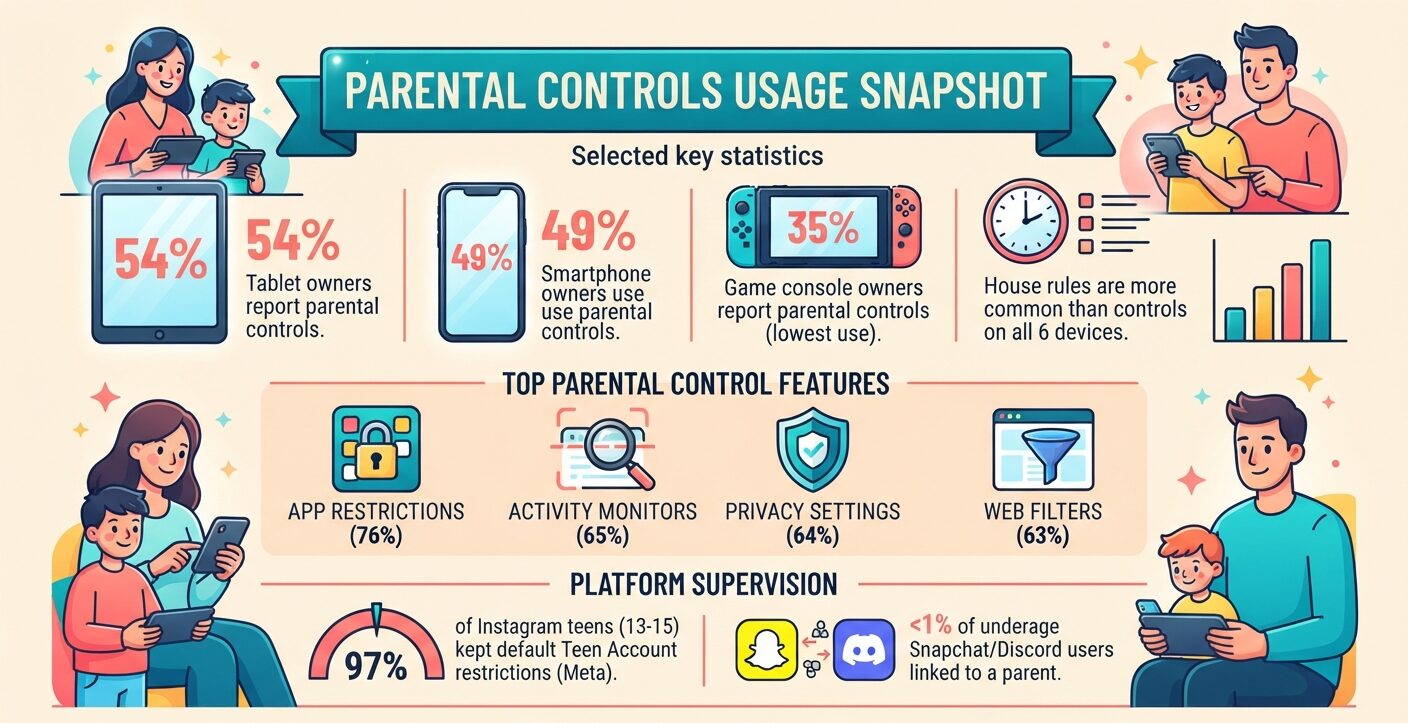
Two published figures frame the current data. In FOSI’s spring 2026 survey, 54% of tablet owners reported parental controls on the device, and Meta says 97% of Instagram users aged 13 to 15 stayed in its automatic Teen Account restrictions. This guide covers parental control usage by device, house rules, the features families pick, platform supervision tools, what supervised children do on their phones and software market revenue.
Parental Controls Usage Statistics
How Many Parents Use Parental Controls in 2026?
Just over half of tablet owners use them, and use drops on every other screen. FOSI’s Wave Four Online Safety Survey, fielded by Ipsos from March 17 to April 6, 2026, asked parents and children in the US and Australia which devices had controls set.
| Device | Owners reporting parental controls |
|---|---|
| Tablet | 54% |
| Smartphone | 49% |
| Desktop computer | 47% |
| Laptop | 44% |
| Smart TV | 38% |
| Game console | 35% |
Source: Family Online Safety Institute (FOSI), Beyond Borders, Online Safety Survey Wave Four, March–April 2026. Base: US and Australian parents and children who own the device and say the child can access it.
FOSI’s spring 2025 US-only release, based on 1,000 parents of 10- to 17-year-olds, put tablets at 51% and consoles at 35%. The two waves used different samples, so the figures are not a trend line.
Gaming hardware carries its own settings layer. Valve, for example, added hourly and daily playtime limits and playtime reports in its Steam Families rollout.
Portable gaming PCs ship with settings too, and handhelds such as the ROG Ally X list parental controls among their device features.
Two-Parent vs Single-Parent Homes
Households with two parents were more likely than single-parent households to set controls on each device type FOSI tracked. The widest gap was on smartphones, where FOSI reports multi-parent households were 11% more likely to use them.
Source: FOSI, Beyond Borders, Wave Four, March–April 2026.
House Rules Beat Parental Controls on All Six Devices
On game consoles, 61% of owners reported at least one house rule, while 35% reported controls. Smartphone owners reported 68% for rules and 49% for controls.
Younger children face more rules. Among households with smartphone access, 75% of those with 10- to 13-year-olds had a rule, against 62% of those with 14- to 17-year-olds.
Source: FOSI, Beyond Borders, Wave Four, March–April 2026. Base: US and Australian device owners.
Pew: 86% of Parents Set Screen Rules, 19% Always Stick to Them
Pew Research Center surveyed 3,054 US parents of children aged 12 and under from May 13 to 26, 2025. 86% have rules on when, where or how their child uses screens, and 42% say they could manage screen time better.
| How often parents stick to screen rules | Share of parents |
|---|---|
| All the time | 19% |
| Most of the time | 55% |
| Sometimes | 11% |
| Rarely or never | 2% |
Source: Pew Research Center, How Parents Manage Screen Time for Kids, survey conducted May 13–26, 2025.
Which Parental Control Features Do Families Use Most?
App restrictions lead. In FOSI’s Wave Four, 76% of parents and children who use controls said the parent limits access to certain content and apps (n = 2,496).
Activity monitors (65%), privacy settings (64%) and web filters (63%) follow. Respondents could name several types, so the shares overlap and do not sum.
Source: FOSI, Beyond Borders, Wave Four, March–April 2026. Base: US and Australian parents and children who use parental controls.
Do Parental Controls Work?
People who use them mostly say yes. Between 81% and 86% of parents and children rated each control type effective, depending on the control.
Children split on the experience. 55% with controls say they can still do what they want online, and 48% wish parents would ask their opinion before setting them.
Source: FOSI, Beyond Borders, Wave Four, March–April 2026.
Parental Controls Usage by Platform: Snapchat, Discord and Instagram
Opt-in family centers linked fewer than 1% of minors to a parent on Snapchat and on Discord. The companies disclosed the counts in written responses to the US Senate Judiciary Committee, reported by NBC News.
| Platform tool | Linked parents | Linked minor accounts | Under-18 base disclosed |
|---|---|---|---|
| Snapchat Family Center | 200,000 | 400,000 | 60 million global daily active users |
| Discord Family Center | 15,000 | 15,500 | About 2.7 million US monthly active users |
Source: NBC News, company responses to the Senate Judiciary Committee, late March 2024.
Meta’s Teen Accounts switch on by default. Meta reported at least 54 million active Teen Accounts globally as of April 2025, and said 97% of teens aged 13 to 15 stayed in the built-in restrictions.
Source: Meta Newsroom, Teen Accounts update, April 2025.
Discord said on September 22, 2026 that it would roll out age verification to all users the next day. Its CTO said more than 90% of users would not have to verify their age.
Source: TechCrunch, September 22, 2026.
How Much Do Parents Trust Tech Companies?
Just 27% of parents in FOSI’s Wave Four said tech companies are effective at protecting their children from harmful content. Among children, 41% said the same.
Source: FOSI, Beyond Borders, Wave Four, March–April 2026.
Pew found 67% of US parents of children 12 and under want tech companies to do more to set rules for what kids see or do online. 55% say the same of lawmakers.
Source: Pew Research Center, survey conducted May 13–26, 2025.
What Do Supervised Kids Do Online? Kaspersky Safe Kids Data
Kaspersky’s figures come from anonymized data on devices already running Safe Kids, so they describe supervised children only. From May 2025 to April 2026, YouTube took 29.06% of time spent across the top 25 Android apps.
WhatsApp ranked second at 16.18% and TikTok third at 12.09%. Roblox placed fourth at 9.22%, and gaming forums have tracked how Roblox playtime compares with Steam and PlayStation.
Source: Kaspersky, kids report 2026, Android app time share, May 2025–April 2026.
Where Web Filters Trigger: Windows vs Mobile
Software, audio and video sites drew 63.09% of triggered events on Windows but 38.90% on Android and iOS. Internet communication ran the other way.
| Website category | Windows | Android and iOS |
|---|---|---|
| Software, audio, video | 63.09% | 38.90% |
| Internet communication | 23.20% | 33.22% |
| Video games | 2.66% | 6.90% |
| E-Commerce | 2.03% | 6.43% |
| News media | 3.52% | 3.76% |
| Adult content | 1.33% | 4.25% |
Source: Kaspersky, kids report 2026, share of Safe Kids web-category events, May 2025–April 2026.
AI tools made up at least 41.36% of searches in the Apps and tools category of children’s Google queries from March to May 2026.
Source: Kaspersky, kids report 2026, March–May 2026.
USD 1.57 Billion: Parental Control Software Market Size in 2025
Fortune Business Insights values the global parental control software market at USD 1.57 billion in 2025. It projects USD 1.76 billion in 2026 and USD 4.12 billion by 2034, a CAGR of 11.20% over 2026–2034.
These are vendor revenue estimates. The report’s stated scope includes Microsoft Family Safety, Google Family Link, Kaspersky Safe Kids for PC, Norton Family, Avast Family Shield and AT&T Secure Family.
| Region | 2025 revenue | 2025 share | 2026 projection |
|---|---|---|---|
| North America | USD 0.53 billion | 33.50% | USD 0.58 billion |
| Europe | USD 0.44 billion | 28.10% | USD 0.49 billion |
| Asia Pacific | USD 0.38 billion | 24.10% | USD 0.44 billion |
| Middle East & Africa | USD 0.13 billion | 8.40% | USD 0.15 billion |
| Latin America | USD 0.09 billion | 5.80% | USD 0.10 billion |
Source: Fortune Business Insights, Parental Control Software Market report, updated September 7, 2026 (2025 base year, 2026 estimate).
Other research firms publish different totals under their own scope definitions. The Insight Partners, for instance, puts the 2025 market at US$1.52 billion.
Source: The Insight Partners, Parental Control Software Market report, April 2026.
FAQs
What percentage of parents use parental controls?
It depends on the device. In FOSI’s spring 2026 survey of US and Australian families, 54% of tablet owners reported controls, compared with 49% for smartphones and 35% for game consoles.
Do parental controls actually work?
Most users say so. Between 81% and 86% of parents and children using controls rated each type effective in FOSI’s Wave Four survey, fielded March to April 2026.
How many parents use Snapchat Family Center?
About 200,000 parents were linked to 400,000 teen accounts, out of 60 million global daily users under 18, per Snap’s 2024 responses to the Senate Judiciary Committee reported by NBC News.
Which device has the lowest parental control use?
Game consoles. FOSI’s Wave Four found 35% of console owners reported controls, the lowest of six devices tracked, while 61% reported at least one house rule for the console.
Reddit threads often say most families skip parental controls. Is that accurate?
Partly. FOSI’s spring 2026 data shows controls on 54% of tablets but on under half of smartphones (49%), desktops (47%), laptops (44%), smart TVs (38%) and game consoles (35%).
