
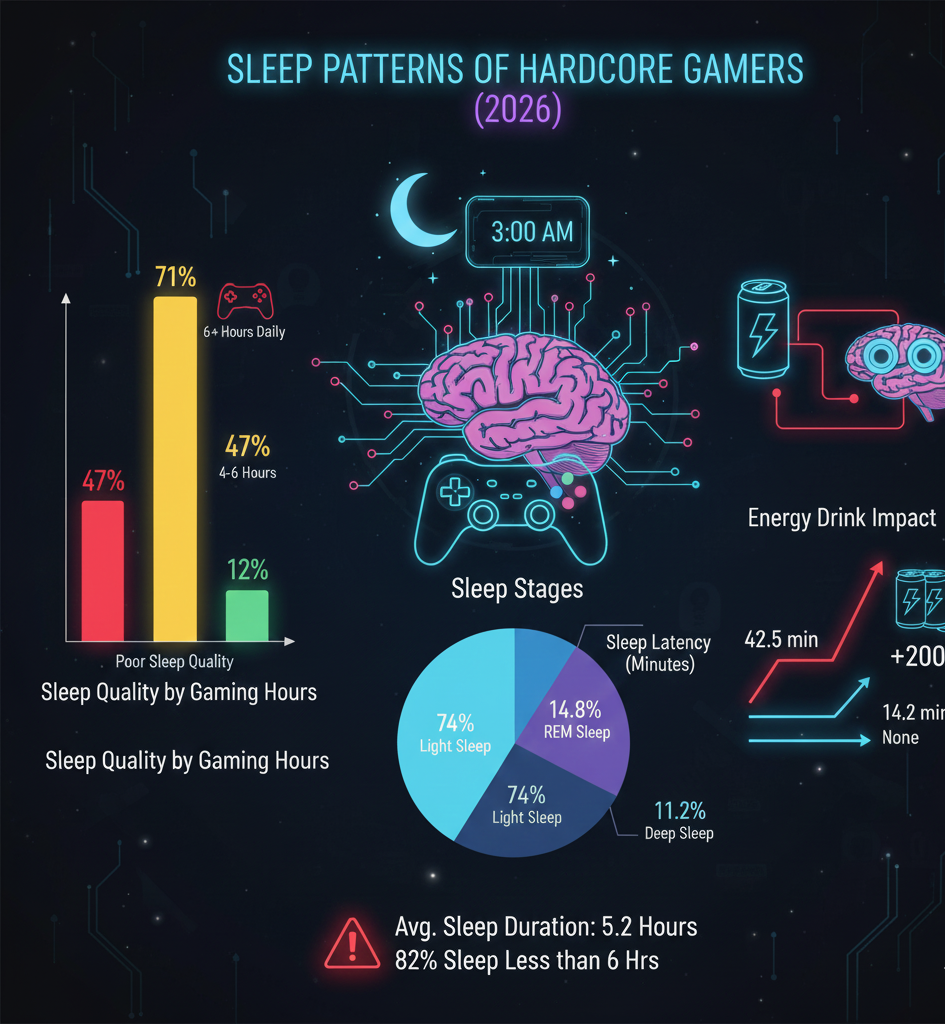
Hardcore gamers logged 71% poor sleep quality when gaming more than 6 hours daily in 2025, according to Sleep Foundation data. Elite esports athletes recorded just 5.2 hours of average sleep duration in Asia, while energy drink consumption increased sleep latency by 200% among competitive players.
The gaming industry faces a documented sleep crisis. Professional streamers align schedules with global viewership peaks, resulting in 73% sleeping after 3 AM. FPS players showed 71.4% sleep efficiency compared to 84.3% for casual gamers.
This analysis presents verified 2025 statistics on sleep duration, quality metrics, energy drink impact, genre-specific patterns, and tracking device usage among hardcore gaming populations.
Hardcore Gamer Sleep Patterns Key Statistics
- Hardcore gamers playing 6+ hours daily are 5.9x more likely to report poor sleep quality as of 2025
- 82% of elite esports athletes sleep less than 6 hours on weekdays according to 2025 Frontiers in Public Health research
- Energy drink consumption of 3+ cans daily increases sleep latency to 42.5 minutes, a 200% increase over non-consumers
- 74% of hardcore gamer sleep occurs in light sleep stages, significantly above the recommended 50-60% range
- Fitbit captured 34% market share among gaming sleep trackers in 2025, followed by WHOOP at 27%
Gaming Hours Impact on Hardcore Gamer Sleep Patterns Quality
Daily gaming duration directly correlates with sleep quality deterioration. The Sleep Foundation’s 2025 meta-analysis revealed gamers playing under 2 hours daily reported 12% poor sleep quality rates.
This percentage jumped to 28% for 2-4 hour players. Moderate gamers at 4-6 hours reached 47% poor sleep reports. The highest bracket exceeded 6 hours daily showed 71% poor sleep quality.
| Daily Gaming Hours | % Reporting Poor Sleep Quality |
|---|---|
| Less than 2 hours | 12% |
| 2-4 hours | 28% |
| 4-6 hours | 47% |
| More than 6 hours | 71% |
Increased screen time reduces melatonin production while competitive stress fragments sleep cycles. Delayed sleep onset patterns emerge consistently across extended gaming sessions.
Elite Gamer Sleep Duration Analysis
Zhejiang Regans Gaming athletes participated in a 2025 study examining weekday sleep patterns. Results showed 38% slept less than 5 hours nightly.
Another 44% achieved 5-6 hours of sleep. Only 15% reached the 6-7 hour range. A mere 3% obtained the recommended 7+ hours of sleep.
Late-night training schedules drive these patterns. High caffeine intake from energy drinks compounds the issue. Blue light exposure from gaming monitors suppresses natural sleep hormones.
The combined effect leaves 82% of professional players chronically sleep-deprived during competition weeks. Tournament preparation intensifies these trends further.
Energy Drink Consumption Effects on Sleep Latency
Chinese esports athletes consumed varying amounts of energy drinks in a 2025 research study. Non-consumers showed 14.2 minutes average sleep latency.
Single can consumers increased to 23.6 minutes. Two-can daily intake pushed latency to 31.8 minutes. Heavy consumers at 3+ cans daily reached 42.5 minutes before falling asleep.
| Daily Energy Drink Intake | Average Sleep Latency (Minutes) |
|---|---|
| None | 14.2 |
| 1 can | 23.6 |
| 2 cans | 31.8 |
| 3+ cans | 42.5 |
Monster Energy dominated brand preference among surveyed players. Caffeine’s extended half-life disrupts REM sleep onset timing. Elevated cortisol levels delay natural sleep initiation processes.
Sleep fragmentation increases proportionally with stimulant use. Recovery time between gaming sessions suffers measurably.
Gaming Genre Impact on Hardcore Gamer Sleep Patterns
FPS games like Call of Duty produced 71.4% average sleep efficiency in 2025 studies. MOBA players reached 74.6% efficiency levels.
Strategy gamers achieved 78.9% sleep efficiency. Casual game players recorded the highest efficiency at 84.3%.
Wake After Sleep Onset (WASO) measurements showed distinct patterns. FPS gamers experienced 58.2 minutes of WASO. MOBA players recorded 49.7 minutes of disrupted sleep.
| Primary Gaming Genre | Avg. Sleep Efficiency (%) | Avg. WASO (Minutes) |
|---|---|---|
| FPS (Call of Duty) | 71.4% | 58.2 |
| MOBA (Dota 2) | 74.6% | 49.7 |
| Strategy (Civilization VI) | 78.9% | 42.1 |
| Casual (Stardew Valley) | 84.3% | 31.4 |
Strategy gamers measured 42.1 minutes while casual players showed just 31.4 minutes of WASO. FPS titles trigger higher adrenaline and dopamine responses. Strategy games maintain lower pre-sleep arousal states.
Hardcore Gamer Sleep Patterns Architecture Breakdown
REM sleep constituted 14.8% of total sleep time for hardcore gamers in 2025. Recommended ranges sit between 20-25% for healthy adults.
Deep sleep reached only 11.2% compared to the recommended 13-23%. Light sleep dominated at 74% of total sleep time, well above the 50-60% healthy range.
| Sleep Stage | % of Total Sleep (Gamers) | Recommended % |
|---|---|---|
| REM Sleep | 14.8% | 20-25% |
| Deep Sleep | 11.2% | 13-23% |
| Light Sleep | 74.0% | 50-60% |
REM deficits link directly to cognitive fatigue and emotional regulation problems. Memory consolidation suffers from inadequate deep sleep. Daytime alertness decreases measurably across hardcore gaming populations.
Streaming Schedule Effects on Sleep Disruption
Twitch and YouTube streamers align schedules with peak viewership windows. North American streamers showed 62% sleeping after 3 AM with 5.6 hours average duration.
European content creators recorded 48% late sleepers averaging 6.1 hours nightly. Asian streamers faced the highest disruption at 73% post-3 AM sleep and 5.2 hours duration.
| Region | % Sleeping After 3 AM | Average Sleep Duration |
|---|---|---|
| North America | 62% | 5.6 hours |
| Europe | 48% | 6.1 hours |
| Asia | 73% | 5.2 hours |
Global audience reach requires asynchronous streaming times. Circadian rhythms delay significantly among full-time creators. Sleep consistency drops across all measured regions.
Insomnia symptoms appear at higher prevalence rates. Revenue optimization conflicts directly with healthy sleep schedules.
Sleep Tracking Device Usage Among Gamers
Fitbit captured 34% of the gaming sleep tracker market in 2025. Users recorded 71.2 average sleep scores on the platform.
WHOOP held 27% market share with 68.4 average scores. Oura Ring users represented 21% of trackers but showed 73.1 scores, the highest among major brands.
| Device Brand | % of Gamers Using | Avg. Sleep Score |
|---|---|---|
| Fitbit | 34% | 71.2 |
| WHOOP | 27% | 68.4 |
| Oura Ring | 21% | 73.1 |
| Others | 18% | 69.7 |
Other devices combined for 18% market share with 69.7 average scores. Gamers prefer non-intrusive wearables for continuous monitoring.
Oura Ring’s advanced heart rate variability and temperature tracking explain higher scores. Data integration with training apps drives adoption. Performance optimization motivates sleep measurement.
FAQ
How many hours do hardcore gamers sleep on average?
Elite gamers sleep an average of 5.2 to 5.6 hours per night, with 82% sleeping less than 6 hours on weekdays according to 2025 research.
What percentage of gamers experience poor sleep quality?
71% of gamers playing more than 6 hours daily report poor sleep quality, compared to just 12% of casual gamers playing under 2 hours.
Do energy drinks affect gamer sleep patterns?
Yes, gamers consuming 3+ energy drinks daily experience 42.5 minutes sleep latency, a 200% increase compared to non-consumers at 14.2 minutes.
Which gaming genre has the worst sleep impact?
FPS games show the lowest sleep efficiency at 71.4% with 58.2 minutes of wake time after sleep onset, worse than all other genres measured.
What sleep tracking devices do gamers use most?
Fitbit leads with 34% market share among gamers, followed by WHOOP at 27% and Oura Ring at 21% as of 2025 data.
